ADJACENT TO PRACTICE
Access Council Report: here
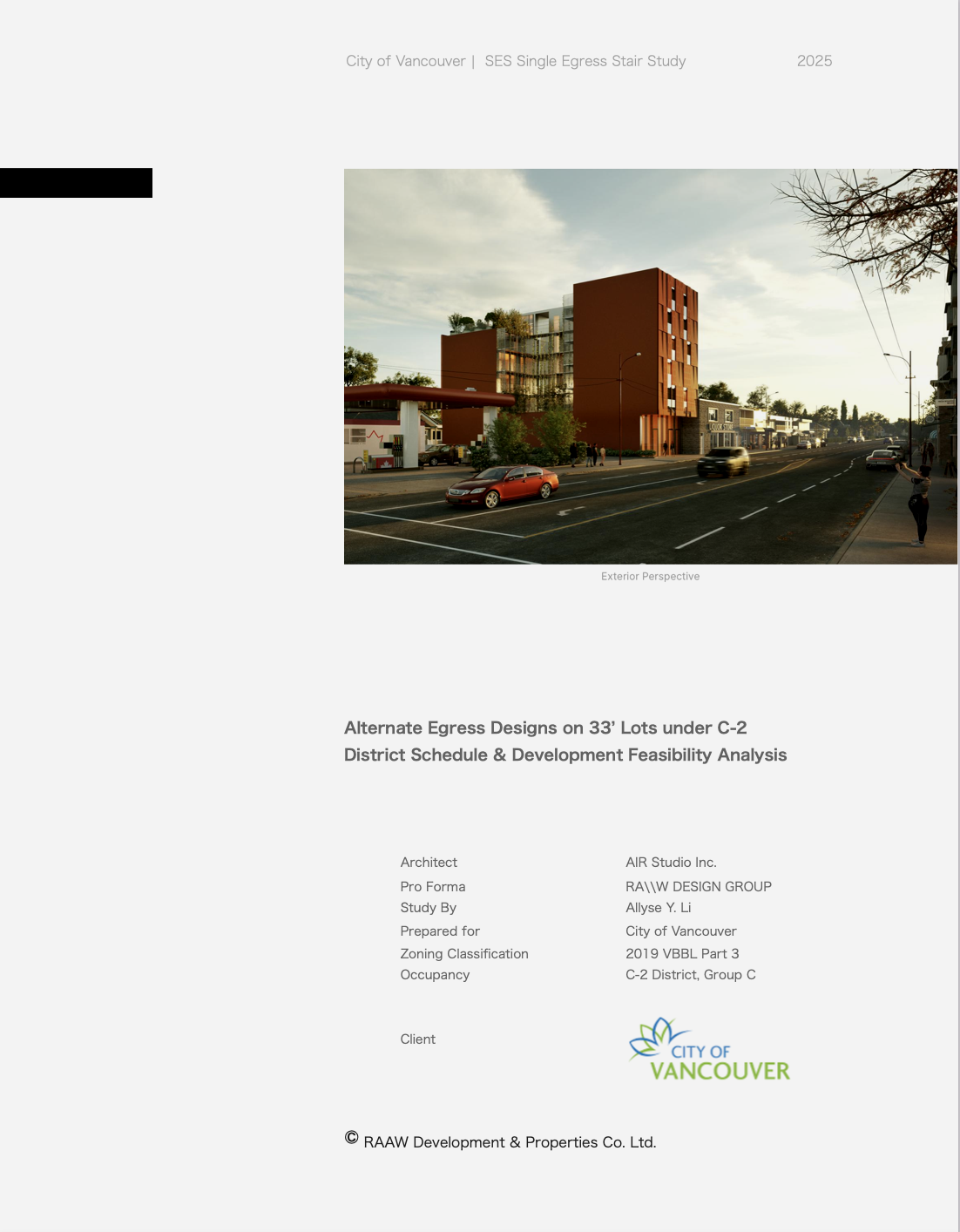
This study presents a comprehensive Pro Forma supported architectural analysis of alternative egress designs for 33-foot lots within the C-2 District Schedule in the City of Vancouver. This report provides a comparative framework and feasibility assessment for four egress options applicable to the narrow lot typology. Where traditionally, the standard lot width of 33’ (10m) is often assembled as multiple adjacent properties, combined to develop large mid-rise buildings (with double loaded corridor floor plan served by two exit stairs), this study utilizes the pro forma feasibility study for real estate development, asking the critical question: How are alternative egress solutions performing in their financially outlook compared to existing options?
In December 2025, Vancouver City Council unanimously approved changes to the Vancouver Building Bylaw (VBBL) to enable exterior SES. Learn more.

Our research spans across scale in the built environment, pivoting on the spatial economics of the internal life. Leveraging the design-led approach, our research aims to seek socio-economically viable solutions that look beyond existing response measures for the housing crisis. Vancouver in particular, champions such ranking as the least affordable in Canada amongst other growing urban centres, and is the third least affordable city globally [1]. Do elevated design aggravate gentrification? How can designers contribute to shaping more generous built environments (and way of life)?
[1] Based on The Global Liveability Index 2023, EIU report.

City of Burnaby, Transit Oriented Development
The possibility to build generational-wealth through home ownership for individuals and their families allows a community to build up long term resilience. Equity inclusivity for all urban stakeholders is critical, especially middle income households. Here, our underlying ideal is simple: those who contribute to the city and its operations, growth and vitality should not be excluded from the growth of the city — by defining (re-defining) ‘housing’ as more-than a market commodity: ’housing’ is a universal need in the urban setting. How can socially responsive design thinking address the economics of our built environment and empower private sector participants to exercise financially sustainable solutions in a democratic capitalism framework?

City of Vancouver, Missing Middle Density, R1-1
Prioritizing climate action planning on the basis of equity and empowering housing accessibility on the basis of welfare are fundamental to ensuring community resilience in an urban context. Our work hypothesizes on new housing typologies and models in real estate development that support alternative social and economic dynamics, and are suggestive of practical applications for an interdisciplinarity of design thinking across scale. Our capacity as designer, residential builder and real estate developer positions our research to discover new synergies in design-led, development practice that is backed by market tested interventions intersecting urban intensification, affordability and real estate feasibility.

INQUIRIES
Research content contributed by Allyse Y. Li. Connect on LinkedIn for academic inquiries and collaboration for research related subject matter.
Read LI’s Bio and more.
All contents original, subjected to copyright by its author.